
The first time I asked ChatGPT to help with a genuinely complex problem, I had a familiar reaction: Is this going to replace me?
The task on my plate would have taken days—maybe weeks—to reason through properly. In seconds, the model produced something that looked plausible, even elegant.
It was also incomplete, subtly wrong in places, and blind to several constraints that mattered in production.
That moment clarified something important: AI is not a solution to software engineering problems. It is a tool. And like every powerful tool we’ve adopted over the last few decades, it amplifies the skill—or the absence of it—of the person using it.
The engineers who will thrive in the AI era won’t be the ones who type the fastest or prompt the cleverest. They’ll be the ones who can reason deeply, challenge assumptions, and make sound engineering decisions when the answers aren’t obvious.
AI Generates Code, Engineers Create Systems
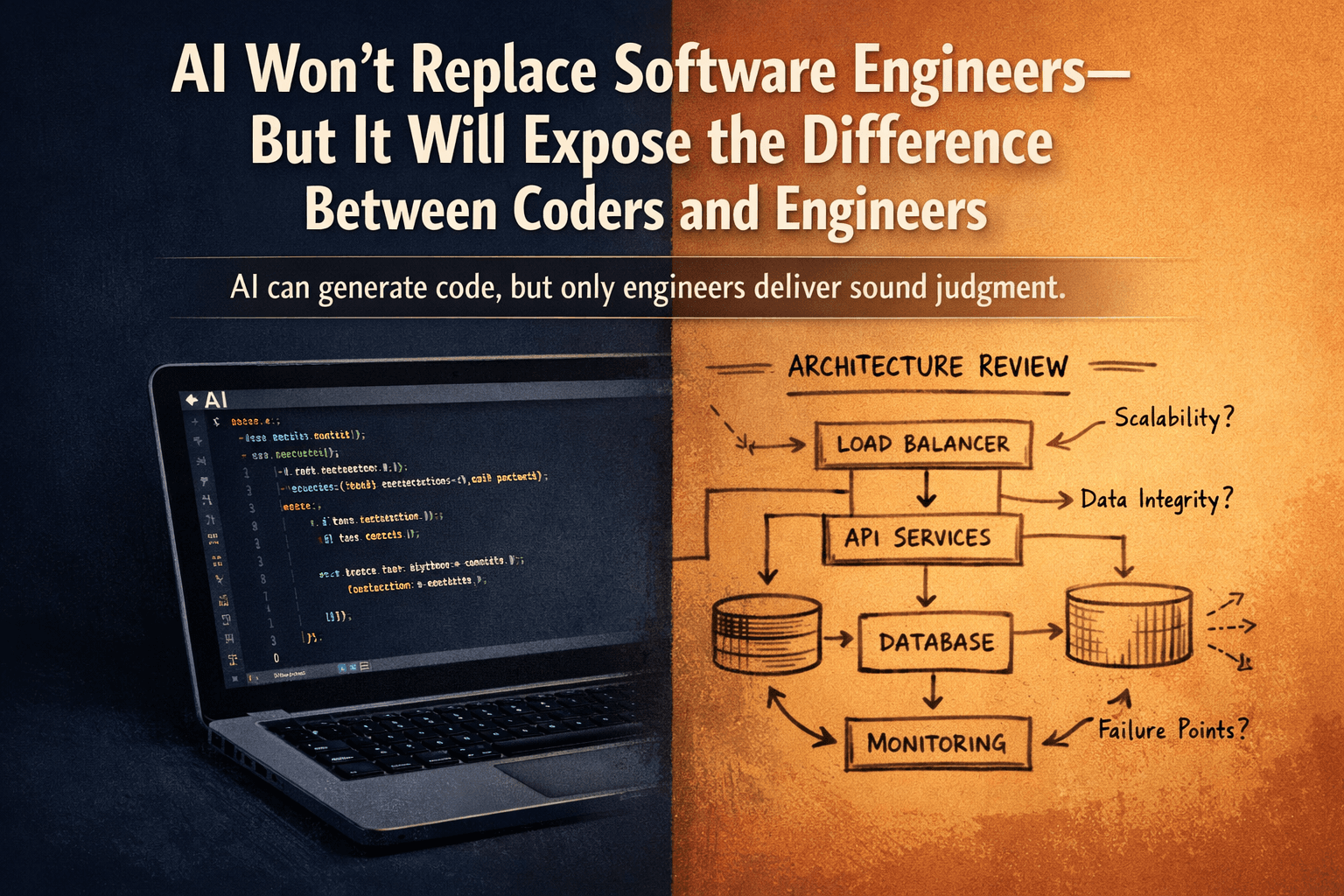
AI can write functions, refactor classes, and even sketch architectures. What it cannot do is own the problem.
It doesn’t understand business trade-offs specific to your organization.
It doesn’t feel operational pain at 2 a.m. when a system degrades under load.
It doesn’t carry accountability for security incidents, data loss, outages, or long-term maintainability.
Those responsibilities still belong to engineers.
In real engineering work—design reviews, incident response, performance tuning, architectural migrations—the hard part is rarely syntax. The hard part is deciding what should exist, why it should exist, and which risks you are consciously accepting by building it that way.
AI can participate in these conversations. It cannot replace the judgment that drives them.
AI in Unskilled Hands Is a Liability
One of the most persistent myths around AI is that it “levels the playing field.” In practice, it widens the gap.
Experienced engineers treat AI output as a hypothesis, not an answer. They interrogate it against constraints the model does not know: production traffic patterns, regulatory requirements, legacy integrations, failure histories, and organizational realities. AI accelerates exploration, but judgment remains human.
Less experienced engineers often invert that relationship. They treat AI output as authoritative—especially when it appears confident, well-structured, and complete.
This is where risk compounds.
In production systems, plausibly correct code is often more dangerous than obviously broken code. It passes reviews. It ships. It fails later—under load, during edge cases, or when requirements evolve.
The failure modes are predictable:
- Code paths that ignore non-obvious invariants
- Architectures that collapse under latency, scale, or partial failure
- Clean abstractions that conceal unacceptable operational complexity
- Systems that no one can confidently modify six months later
AI didn’t introduce these problems. It accelerates their creation when engineering judgment is missing.
The uncomfortable truth is this: AI doesn’t eliminate weak engineering—it makes it harder to detect until the cost of fixing it is far higher.
Why Foundations Matter More Now Than Ever
Frameworks age. Tools rotate. Trends fade.
The fundamentals don’t.
As AI accelerates code generation, the gap between engineers who understand first principles and those who don’t will widen. Without a solid foundation, engineers lose the ability to evaluate whether an AI-generated solution is correct, appropriate, or safe.
The foundations that still matter—arguably more than ever—include:
- Algorithms and data structures
- System and API design
- Architectural trade-offs and constraints
- Testing strategies and quality discipline
- Performance, scalability, and reliability thinking
- Writing code meant to be maintained by humans
AI can reference these topics. Only engineers can apply them responsibly within real systems.
Critical Thinking Is the Real Differentiator
The future of software engineering is not about learning how to write better prompts. It’s about learning how to think more rigorously.
Strong engineers continuously ask:
- What assumptions are embedded in this solution?
- What happens when inputs change, load spikes, or requirements shift?
- Where are the failure modes—and how will we detect them?
- What’s the simplest design that can survive the next two years?
AI does not ask these questions unless prompted—and even then, it does not know which answers actually matter in your environment.
Engineers do.
Judgment is not optional. It is the work.
Adapting to AI Without Losing the Craft
AI is not a threat. It is a multiplier.
Used intentionally, it can:
- Accelerate learning in unfamiliar domains
- Improve code reviews by catching mechanical issues
- Explore architectural alternatives quickly
- Speed up debugging and root-cause analysis
- Automate repetitive work that drains focus
Used carelessly, it erodes problem-solving muscles and produces brittle systems no one fully understands.
The discipline is knowing when to use AI and when not to. The responsibility is validating its output with the same rigor you would apply to a junior engineer’s pull request.
Engineering judgment must remain in control.
What Happens If We Ignore This
If we treat AI as a replacement rather than an amplifier, the industry will drift toward:
- Overproduction of code with underdeveloped understanding
- Teams that ship features quickly but cannot sustain systems
- Increased operational risk hidden behind polished abstractions
The cost will not appear immediately. It will surface later—in outages, rewrites, security failures, and burned-out teams tasked with maintaining systems no one truly designed.
A Practical Path Forward
If you’re a software engineer or technical leader today, the path forward is clear:
- Double down on fundamentals
- Practice critical thinking deliberately
- Treat AI as a junior collaborator, not an authority
- Make reasoning and design explicit in reviews and discussions
- Protect the craft of engineering while embracing better tools
AI should elevate engineers—not deskill them.
The future belongs to those who can reason, not just generate.